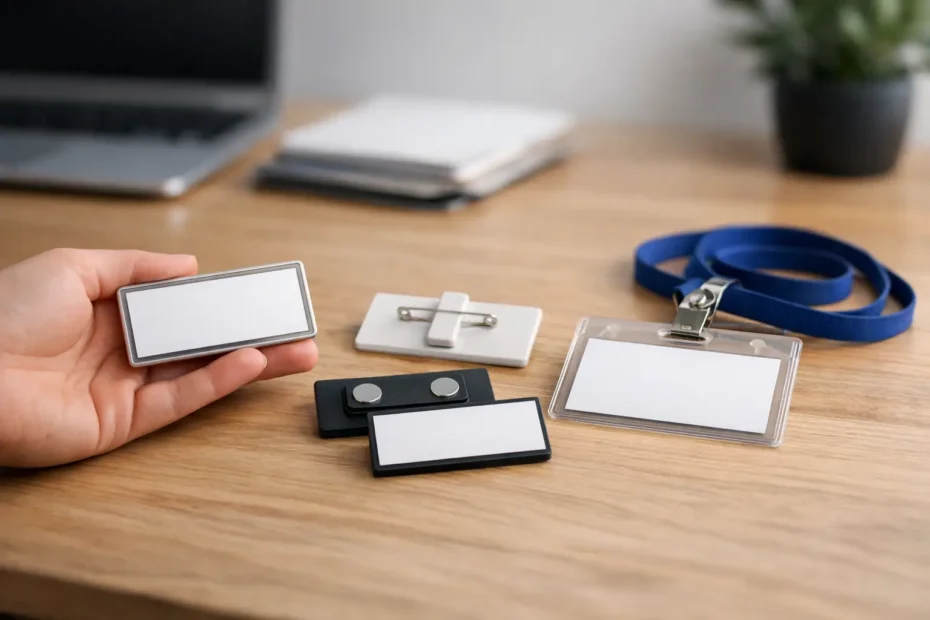
A missing name badge does more damage than most businesses expect. It creates hesitation at reception, awkwardness on the shop floor, and a small but real gap between your team and the people they serve. Well-made name badges for staff solve that quickly. They help customers feel more comfortable, make introductions easier, and give your team a polished, consistent look that supports your brand from the first interaction.
For some workplaces, a badge is mostly about identification. For others, it is part of the customer experience. In hospitality, retail, healthcare, education, and front-office environments, that difference matters. A badge needs to be easy to read, comfortable to wear, and aligned with the image your business wants to present.
Why name badges for staff still matter
When customers know who they are speaking to, service feels more personal. A first name can make an interaction warmer and more direct. In some settings, including a job title or department can also build trust. That is especially useful in schools, clinics, showrooms, and larger offices where visitors need to find the right person quickly.
There is also an internal benefit. Staff name badges can help new team members settle in faster, particularly in growing teams or multi-site businesses. They reduce those awkward moments where people know a face but not a name. That may seem minor, but it improves day-to-day communication and helps teams feel more connected.
From a presentation point of view, badges bring consistency. Even if uniforms vary slightly, matching badges can tie the look together. That is valuable for businesses that want every staff member to represent the brand clearly and professionally.
What makes a good staff badge
The best badge is not always the fanciest one. It is the one that fits your environment, your staff, and the way the badge will actually be used. A corporate office may want a clean metallic finish with a logo and job title. A school or community organization may prefer something simple, durable, and easy to replace. A retail team may need badges that stand out clearly from a distance.
Readability comes first. If customers have to lean in to read a badge, the design is not doing its job. Names should be clear, with enough contrast between the text and the background. Script fonts can look elegant, but they are rarely the best choice for everyday use. Straightforward lettering is usually the smarter option.
Durability matters just as much. A badge worn every day will face knocks, clothing friction, sunlight, and frequent handling. Materials and printing methods should match that reality. If your team works in active roles, a lightweight but hard-wearing option is usually better than something decorative but delicate.
Comfort should not be overlooked. If a badge is heavy, awkward, or damages clothing, staff are less likely to wear it properly. That is where attachment style becomes important.
Choosing the right style of name badges for staff
There is no single best format for every workplace. It depends on who will wear the badge, how often it will be used, and the impression you want to create.
Plastic laminated badges are a popular choice for busy teams because they are practical and cost-effective. They work well for schools, events, community groups, and businesses ordering in larger quantities. They are easy to customize with names, logos, and color branding.
Metal badges often suit corporate, reception, and premium service environments. They can look sharp and professional, especially when paired with engraved or printed branding. They tend to create a more polished first impression, which is why many offices and hospitality businesses prefer them.
Reusable badge systems can be useful if your staffing changes often. If you run events, seasonal promotions, or casual teams, replacing names without reordering the entire badge can save time and cost. The trade-off is that reusable formats do not always look as refined as fully custom permanent badges.
For some teams, photo identification may also be worth considering. That is more common in healthcare, education, and secure workplaces where identification goes beyond customer service and supports safety or access control.
Details that improve the final result
A strong badge design usually includes only what is necessary. Name, logo, and sometimes title are enough in most cases. Trying to fit too much information onto a small surface can make the whole badge harder to read.
Logo placement should feel balanced. If the logo dominates the badge, the staff member’s name becomes secondary, which defeats the purpose. The brand should be visible, but the person wearing the badge should still be the focus.
Color choices matter too. Brand colors can help badges feel consistent with uniforms, signage, and wider business presentation. But contrast is key. A pale logo on a pale background may look nice in a digital proof and still fail in real use.
Size is another decision that should be practical, not just aesthetic. Smaller badges can appear subtle and neat, but they may be harder to read. Larger badges improve visibility, though they can feel bulky depending on the uniform and attachment type. The right balance often comes from thinking about the customer’s distance from the staff member during a typical interaction.
Pin, magnet, or clip?
This is one of the most important choices because it affects both comfort and day-to-day convenience. Pins are secure and widely used, but they can leave small holes in delicate fabrics. Magnets are popular in offices, retail, and hospitality because they avoid fabric damage and are easy to position. However, they may not be ideal for very active roles where movement is constant.
Clips can suit temporary or event use, especially when uniforms vary. They are quick to put on and remove, though they may shift more than other fittings. If your staff wear lanyards, aprons, jackets, or knitwear, it is worth thinking carefully about which attachment will be easiest for them to use consistently.
Ordering for one team or many locations
If you are ordering for a small team, custom choices can be fairly simple. Once quantities increase, consistency becomes more important. Font size, logo placement, colors, and attachment type should stay uniform across the order so every badge feels like part of the same set.
That is especially important for schools, franchises, offices with multiple branches, and larger hospitality groups. A clear process for collecting staff names and titles will also reduce mistakes. Double-checking spelling before production is time well spent. It is one of the few details that can turn a straightforward order into a frustrating reprint.
It can also help to order with future changes in mind. Staff teams rarely stay static. If you expect growth, role changes, or regular new starters, ask for a badge format or ordering approach that makes repeat orders easy. At Award Engravers, that practical side of customization matters just as much as the finished appearance.
When cheaper badges cost more
Low-cost badges can be tempting, especially for bulk orders, but the cheapest option is not always the most economical over time. If the print fades, the fitting fails, or the badge looks tired after a short period, replacement costs add up. More importantly, worn-out badges affect how your business is perceived.
A badge is a small item, but it sits right at the point of interaction. Customers notice if it looks flimsy, scratched, or hard to read. Investing in quality usually means fewer replacements, better presentation, and a result your team is happy to wear.
That does not mean every workplace needs a premium finish. It means choosing a badge that is fit for purpose. A practical everyday badge can still look professional if it is designed well and made to last.
Custom badges that support your brand
The strongest staff badges do more than display a name. They reinforce the way your business wants people to feel when they walk through the door. Welcomed. Reassured. Looked after. Whether your team works in a school office, a sports club, a medical reception, or a busy retail counter, the right badge helps create that experience.
Personalization is what brings the badge to life. A well-placed logo, the right material, and a clear name layout can turn a simple identifier into part of your daily presentation. It is a small detail, but one that works hard every day.
If you are ordering name badges for staff, the smartest choice is usually the one that balances appearance, comfort, and durability without overcomplicating the design. Get those basics right, and your badges will do exactly what they should – help your team feel professional and make every introduction easier.